China–Europe Collaboration Intensifies as BioClima Chinese Delegation Visits Greece and the Netherlands
Press release
 Qi Sun (UT-ITC)
•
Jan. 27, 2026
Qi Sun (UT-ITC)
•
Jan. 27, 2026
In December 2025, the University of Twente – Faculty of Geo-Information Science and Earth Observation (UT–ITC) and NEURALIO AI welcomed a high-level Chinese delegation under the EU-China bilaterial BioClima project (https://bioclima.net/), aimed at strengthening scientific cooperation between China and Europe on biodiversity, ecosystem monitoring, and climate-change research.
The visiting delegation included:
- Prof. Yalan Liu (Chinese Project Coordinator, Aerospace Information Research Institute, Chinese Academy of Sciences (CAS));
- Dr. Chenbin Wang (Nanjing Institute of Environmental Science, representing Prof. Linlu Mei, International Research Center of Big Data for Sustainable Development Goals, Lead of Work Package (WP) 1);
- Dr Renqiang Li (WP2 Lead, Institute of Geographic Information Science, CAS);
- Dr Xiaojing Yao (WP3 Lead, Aerospace Information Research Institute, CAS); and
- Prof. Jianyong Wu (WP5 Lead, Nanjing Institute of Environmental Science).
The visit was led by Prof. Yalan Liu and Dr. Dacheng Wang.
The programme combined scientific presentations, collaborative discussions, field investigations and laboratory tours, providing a comprehensive platform to align research approaches and explore opportunities for joint case studies across BioClima’s European and Chinese demonstration sites.
(1) Chinese Delegation Strengthens Cooperation in Greece
3–5 December 2025 - The delegation visited NEURALIO AI in Thessaloniki, the European lead for WP3: Terrestrial Ecosystem Risk Assessment and Security Risk Early Warning. Researchers presented newly developed systems, including:
- the Climate-Biodiversity Integrated Platform,
- the Earth Intelligence Platform, and
- the Transition system,
Discussions focused on:
- integrated space–air–ground monitoring,
- ground-sensor standardisation,
- cross-border data interoperability, and
- intelligent ecological risk early-warning models.
A joint field campaign took place on 4 December 4 at the Epanomi Wetland Ecological Island (a Natura 2000 protected area with a typical coastal wetland ecosystem). The survey, a sister event to September campaign in Beijing organized by Prof. Linlu Mei and Prof. Robert Brian O'Hara, examined wintering population of the Slender-billed Gull and wetland vegetation distribution patterns. Chinese and Greek experts exchanged methods for wetland ecological monitoring, bird-diversity assessment, UAV aerial survey technology, and long-term phenological data collections. This visit further strengthened cooperation in AI algorithms, system integration, and cross-site ecological applications.
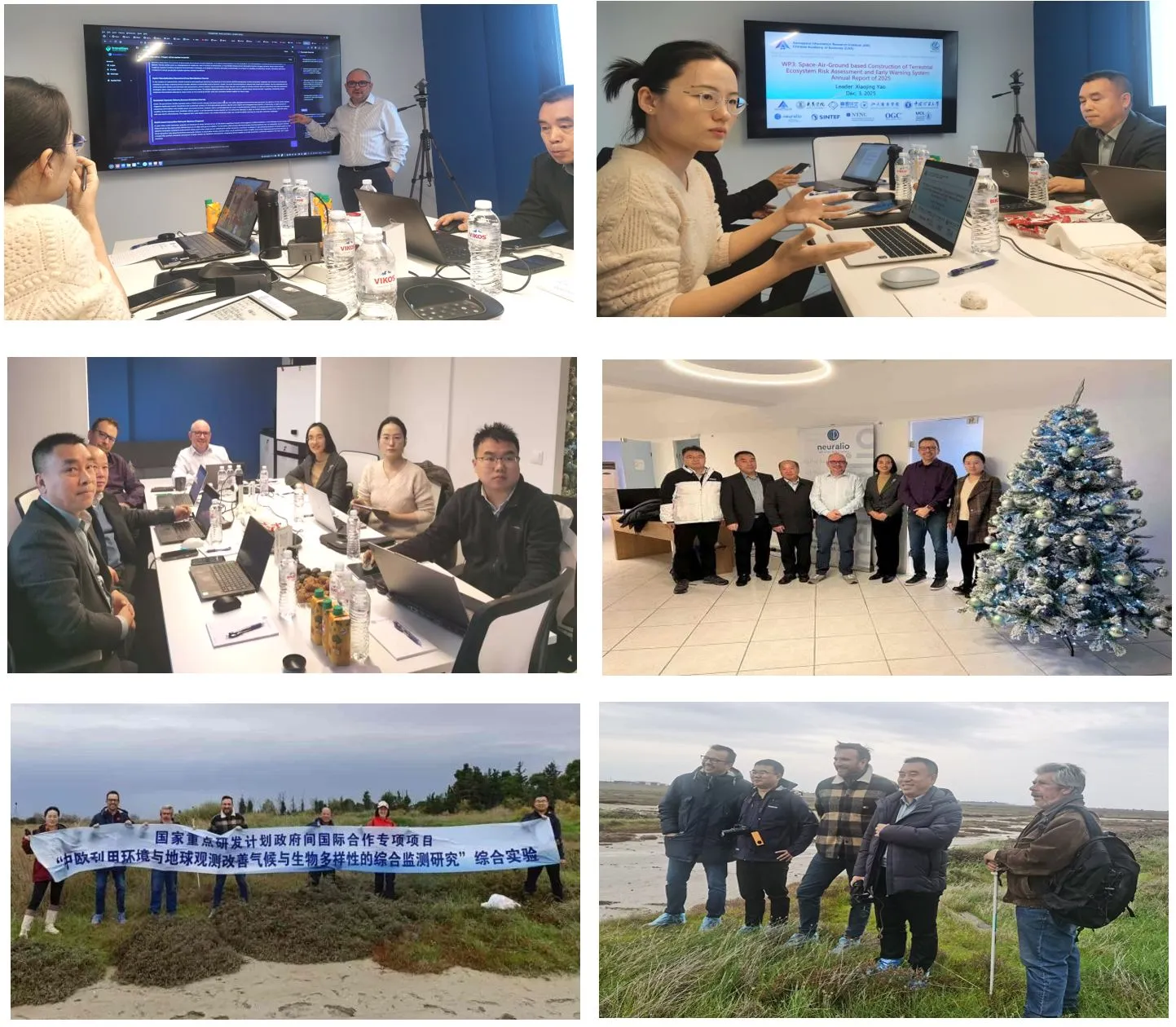
NEURALIO AI Hosted China-Side BioClima Delegation
(2) Collaboration Deepens at the University of Twente
6 to 10 December 2025 - The delegation continued to Enschede, the Netherlands, visiting UT-ITC, the European lead for WP2: Biodiversity conservation and spatial patterns for climate change impacts and adaptation.
Prof. Yalan Liu presented the overall framework of the Sino-European project, including demonstration-site design and data-product development. Assistant Professor Elnaz Neinavaz, the EU WP2 Lead, together with ITC researchers and students, introduced the latest advances in remote sensing of vegetation and biodiversity. Dr. Renqiang Li presented China’s WP2 progress. Dr. Chenbin Wang (on behalf of Prof. Linlu Mei), Dr Xiaojing Yao, and Prof. Jianyong Wu, presented the respective progress of each work package.
Both sides held in-depth discussions on integrating:
- ground-based monitoring,
- satellite remote sensing, and
- climate model outputs
The teams also explored joint demonstration and comparative studies, including potential collaboration in Lefka Ori (White Mountains region of Crete, Greece, ITC's demo-site), comparing with China's demo sites such as Qinghai Plateau and Huangshan-Huaiyu Mountain and the Wuyi Mountains. Plans were formed to create a joint working group using UAV and high-resolution satellite data to assess ecosystem responses to extreme climate events, such as heatwaves.
The additional sessions covered:
- ecosystem functioning and health monitoring,
- harmonisation of Essential Biodiversity Variables (EBVs),
- pest and drought impacts,
- endangered species protection,
- crop productivity under heat stress, and
- biochemical estimation from leaf to canopy scales.
A laboratory tour and a dedicated collaboration workshop provided further opportunities for methods integration and joint planning.
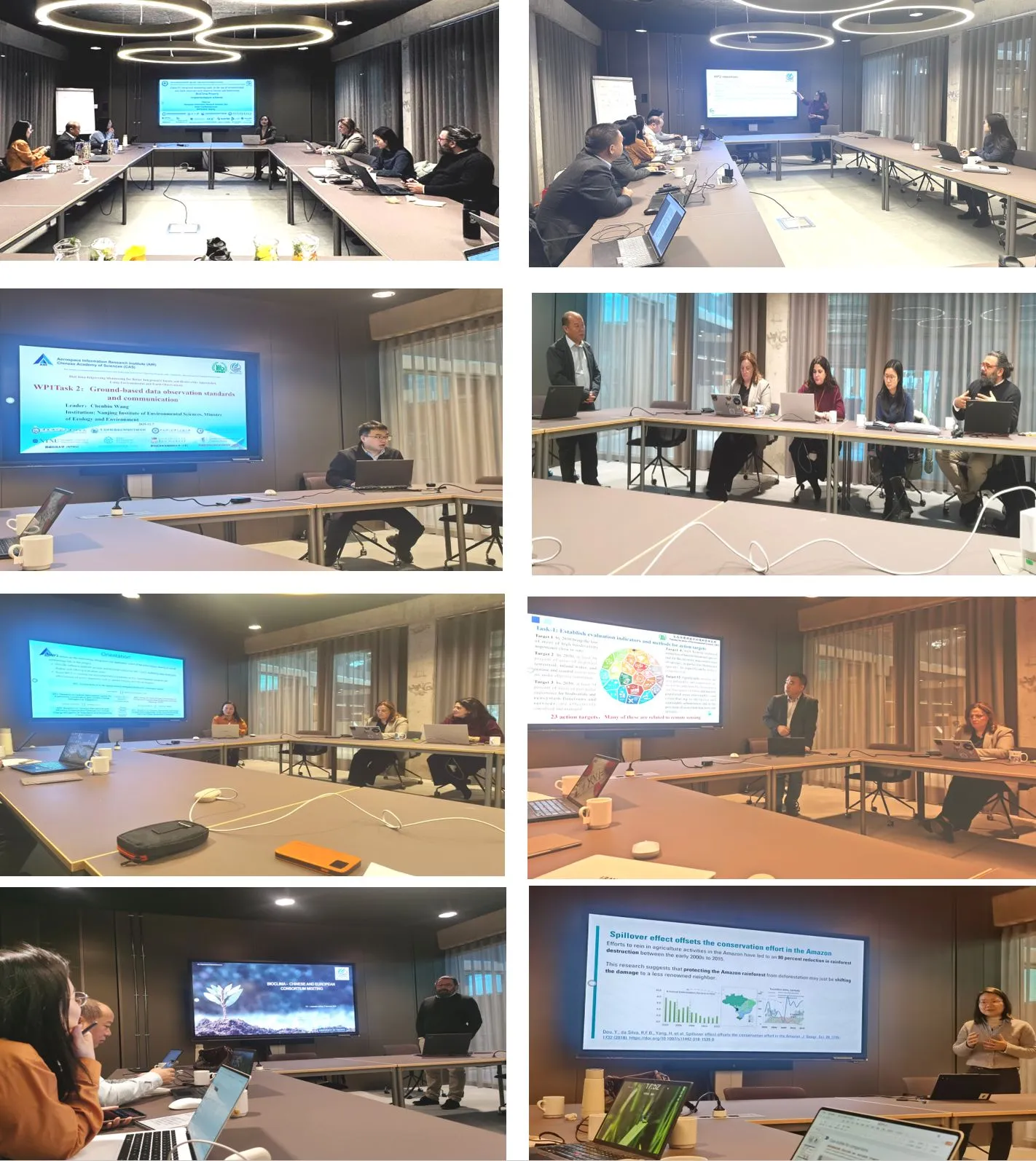
Workshop and discussion at UT-ITC with Chinese Delegation
Advancing a Shared Climate–Biodiversity Vision
The visit reaffirmed BioClima’s commitment to building an integrated, data-driven climate–biodiversity monitoring framework. Both sides agreed to:
- deepen scientific cooperation,
- accelerate integration of observation systems and modelling tools,
- address key technological challenges, and
- advance applied research across Europe–China demonstration sites.
The December exchanges marked a significant milestone in strengthening Sino–European collaboration toward sustainable climate and biodiversity solutions.