Lund University Advances Moth Monitoring and Arctic Vegetation Research
Lund University’s latest BioClima contributions bring together public participation in moth monitoring and satellite analysis of vegetation seasons around Abisko in northern Sweden
 Lars B. Pettersson & Zhanzhang Cai (Lund University)
•
Oct. 21, 2026
How can garden observations and satellite data help us understand biodiversity? Researchers at Lund University are exploring both approaches through their contributions to BioClima. A garden pilot is making moth monitoring more accessible to the public, while research in the European Arctic is examining how the timing of vegetation growth differs between habitats and years.
Bringing Moth Monitoring into Swedish Gardens
Moths are active when many of us are indoors, and identifying them can require considerable expertise. Through his involvement in BioClima’s work on biodiversity monitoring, Lars B. Pettersson is helping explore how simple equipment and identification apps can make these insects easier to observe.
During summer 2026, fifteen gardens belonging to the Trädgårdsresan association in western Sweden took part in a pilot using simple live traps known as “light buckets”. Developed by the Dutch butterfly organisation De Vlinderstichting, the traps were used alongside the ButterflyCount app to support identification and record observations. Moths were photographed and then released.
The pilot recorded a variety of moths, with some still flying in early October. Lars and his colleagues are now compiling the observations and practical experiences, with a continuation planned for next year.
Moths contribute to ecosystems as pollinators and as food for other animals, both as caterpillars and adults. Making monitoring more accessible gives garden owners an opportunity to help document insects that are often overlooked in everyday wildlife observations.
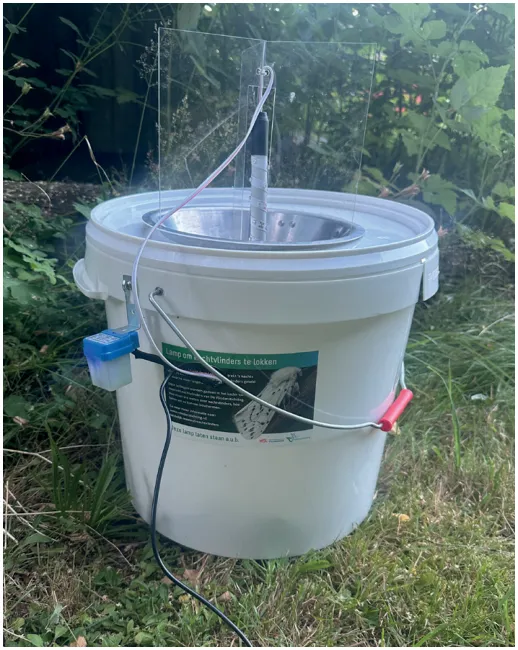
A light bucket in the herb garden at Dals Rostock. Photo: Kerstin Ljungqvist
For more information, visit the Lund University butterfly monitoring contact page https://www.dagfjarilar.lu.se/om-oss/kontakt
Tracking the Growing Season around Abisko
In the European Arctic, Zhanzhang Cai is investigating seasonal vegetation dynamics around Abisko in northern Sweden. This work contributes to BioClima’s WP2 and WP4 and combines the Copernicus Land Monitoring Service’s High-Resolution Vegetation Phenology and Productivity (HR-VPP) products with Sweden’s National Land Cover Database.
Satellite observations covering 2017–2024 allow researchers to compare the beginning and end of growing seasons across habitats, alongside indicators of seasonal vegetation activity.
Preliminary findings show that open wetlands consistently have a later satellite-derived start of the growing season than vegetated open land. The timing also varies substantially between years. These observations provide a detailed view of seasonal differences between habitats, offering information relevant to biodiversity monitoring in Arctic environments.
The findings still require careful validation. Different processing versions were used for 2017–2020 and 2021–2024, and unusually high values of vegetation productivity indicators in 2024 need independent checks. These steps are essential before differences in the data can be interpreted as ecological change.
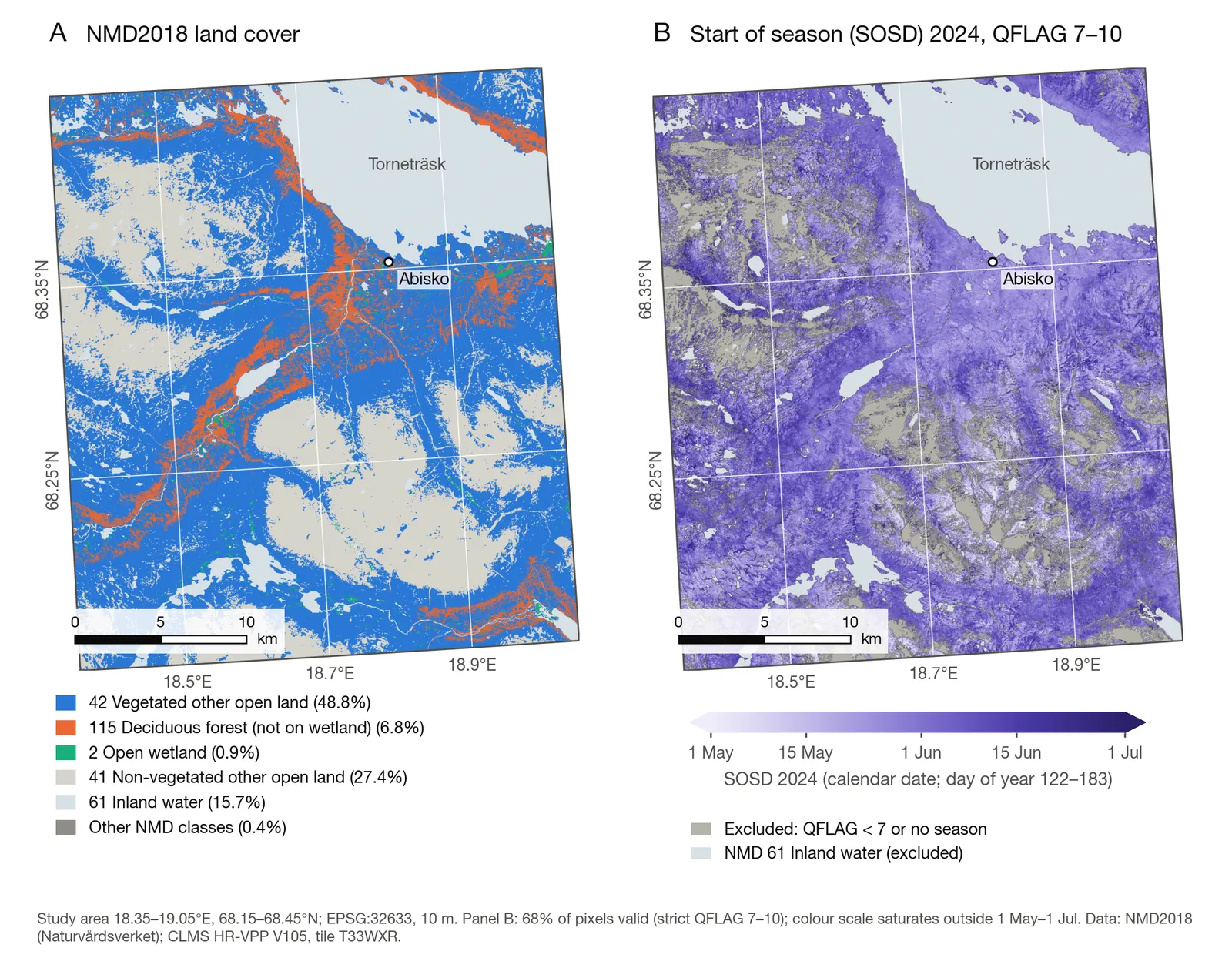
Land cover and the satellite-derived start of the 2024 growing season around Abisko. Figure supplied by Zhanzhang Cai. Data sources: Naturvårdsverket, NMD2018; Copernicus CLMS HR-VPP.
Read more about HR-VPP https://www.sciencedirect.com/science/chapter/edited-volume/abs/pii/B9780443214851000583
Sharing Knowledge on Vegetation Monitoring
Lund University researchers will also contribute to the webinar “Vegetation phenology and productivity across scales”, hosted by the European Environment Agency under the Copernicus Land Monitoring Service on 4 November 2026.
The programme includes contributions from Zhan Zhang Cai, Hongxiao Jin and Lars Eklundh. It will introduce developments in high- and medium-resolution vegetation monitoring products, their complementary uses and potential applications. Registration is required.
View the programme and register.
Together, these activities illustrate how local observations, satellite analysis and knowledge sharing contribute to BioClima’s work on biodiversity and environmental monitoring.
Based on contributions from Lars B. Pettersson and Zhanzhang Cai, Lund University.