Romania Use Case: AI and UAV Technologies Support Biodiversity Monitoring in Diverse Landscapes
UAV and field data collection for biodiversity monitoring
 Ionuț Șandric (University of Bucharest)
•
June 30, 2026
Ionuț Șandric (University of Bucharest)
•
June 30, 2026
Cover photo: Pasture quality mapping in the Iron Gates area. UAV imagery captures open grasslands, scattered trees and rocky slopes used for pasture quality assessment.
The Romania use case has moved into an intensive field data collection phase, combining UAV-based remote sensing with detailed ecological measurements across highly diverse landscapes. This year, two field data collection campaigns have already been completed, each capturing a different seasonal window, while two additional campaigns are planned to complete the seasonal monitoring cycle. This seasonal approach is essential for understanding how vegetation structure, pasture condition, canopy traits and surface temperature patterns change throughout the year.
The field campaigns focused on two contrasting Romanian landscapes: the steppic environments of Dobrogea and the sub-Mediterranean landscapes of the Iron Gates area. Together, these sites offer a valuable natural laboratory for testing how AI and UAV technologies can support biodiversity monitoring in areas where grasslands, forest patches, rocky escarpments, wetlands and water bodies interact.
The aerial images collected during the campaign clearly show this diversity. In the steppic environment, drone imagery captured open grasslands, scattered tree patches and rocky slopes, providing a detailed view of habitat structure and spatial heterogeneity. The image of the rocky escarpment and lake shoreline illustrates the complexity of the landscape, where dry grasslands meet steep geomorphological features and aquatic habitats. These visual contrasts are important because they reflect the ecological gradients that the BioClima team aims to monitor using Earth observation and AI-based analysis.
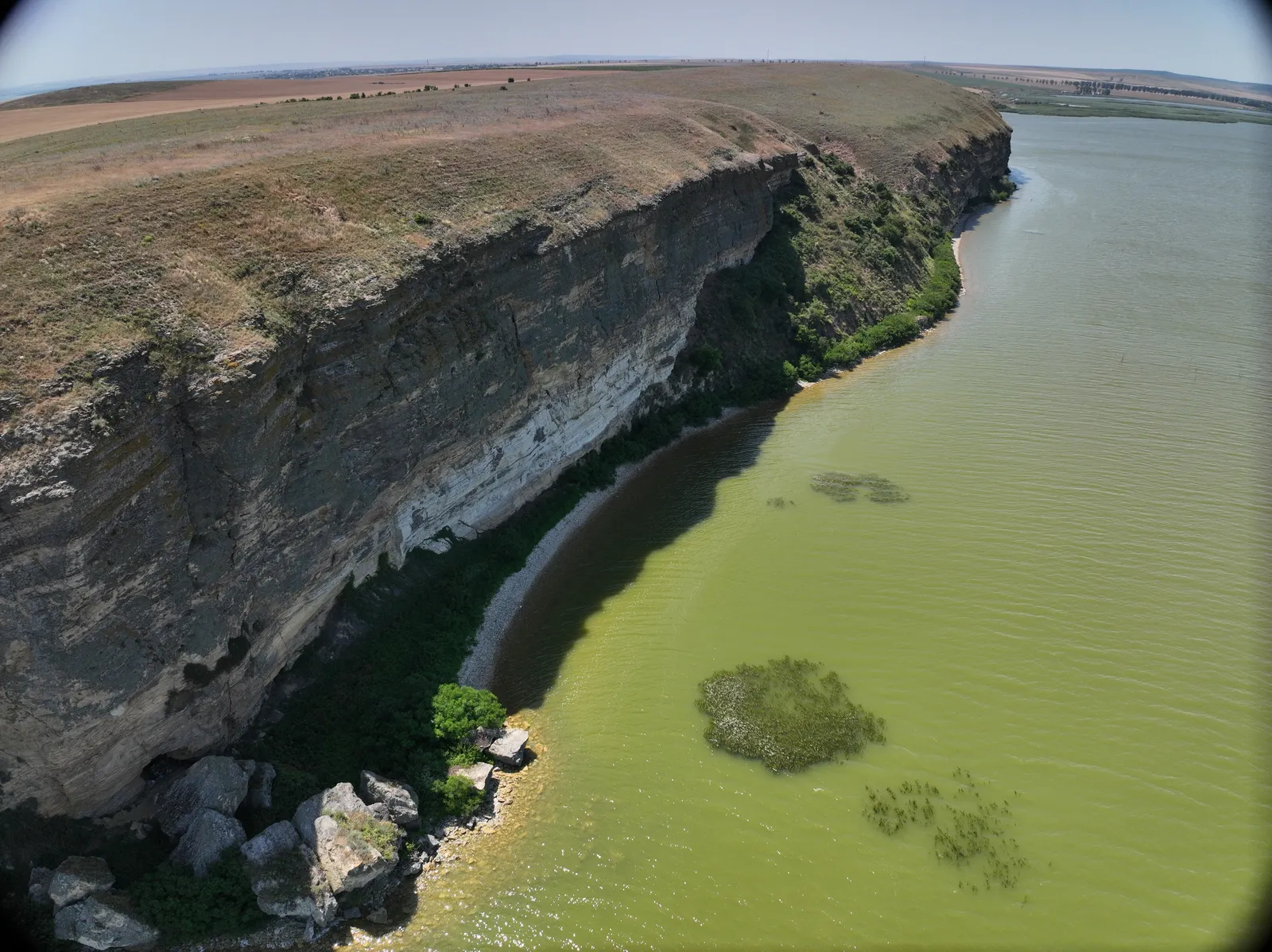
Photo: Steppic landscape and rocky escarpments. Drone imagery highlights the spatial complexity of dry grasslands, steep slopes and lakeshore habitats in the Romanian use case.
During the fieldwork, the team collected complementary UAV datasets using LiDAR, multispectral and thermal sensors. Drone LiDAR was used to capture the three-dimensional structure of vegetation and terrain, supporting the extraction of indicators such as canopy height, vegetation density, terrain morphology and habitat complexity. Multispectral imagery was acquired to assess vegetation condition, productivity and spatial variability. For these flights, multispectral calibration panels were used in the field to ensure that reflectance values are consistent and comparable between sites, flights and seasons.
Thermal UAV imagery was also collected to support land surface temperature mapping and the analysis of microclimatic differences across vegetation types. The thermal image from the field campaign shows the field team and equipment under the forest canopy, highlighting how thermal data can capture temperature contrasts between vegetation, bare ground, vehicles and shaded areas. These data will help explore links between vegetation structure, moisture conditions, exposure and thermal stress.
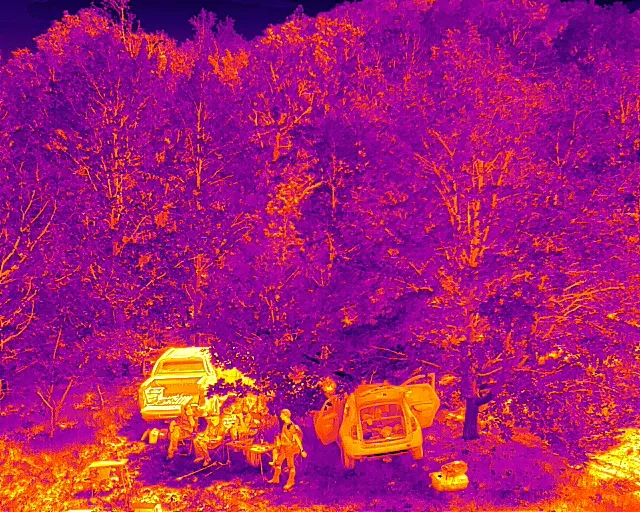
Photo: Thermal mapping during fieldwork. Thermal UAV imagery records temperature contrasts between vegetation, shaded areas, vehicles, equipment and the field team.
In parallel with the UAV flights, the team collected ground-based ecological measurements needed for calibration and validation. Leaf Area Index was measured using a fisheye camera mounted on a tripod beneath the forest canopy. This field setup, shown in the LAI collection photograph, provides information on canopy openness and vegetation structure from below, complementing the top-down perspective provided by drone imagery. Forest plots were also characterised through diameter at breast height and tree-height measurements, which will be used to validate LiDAR-derived canopy metrics
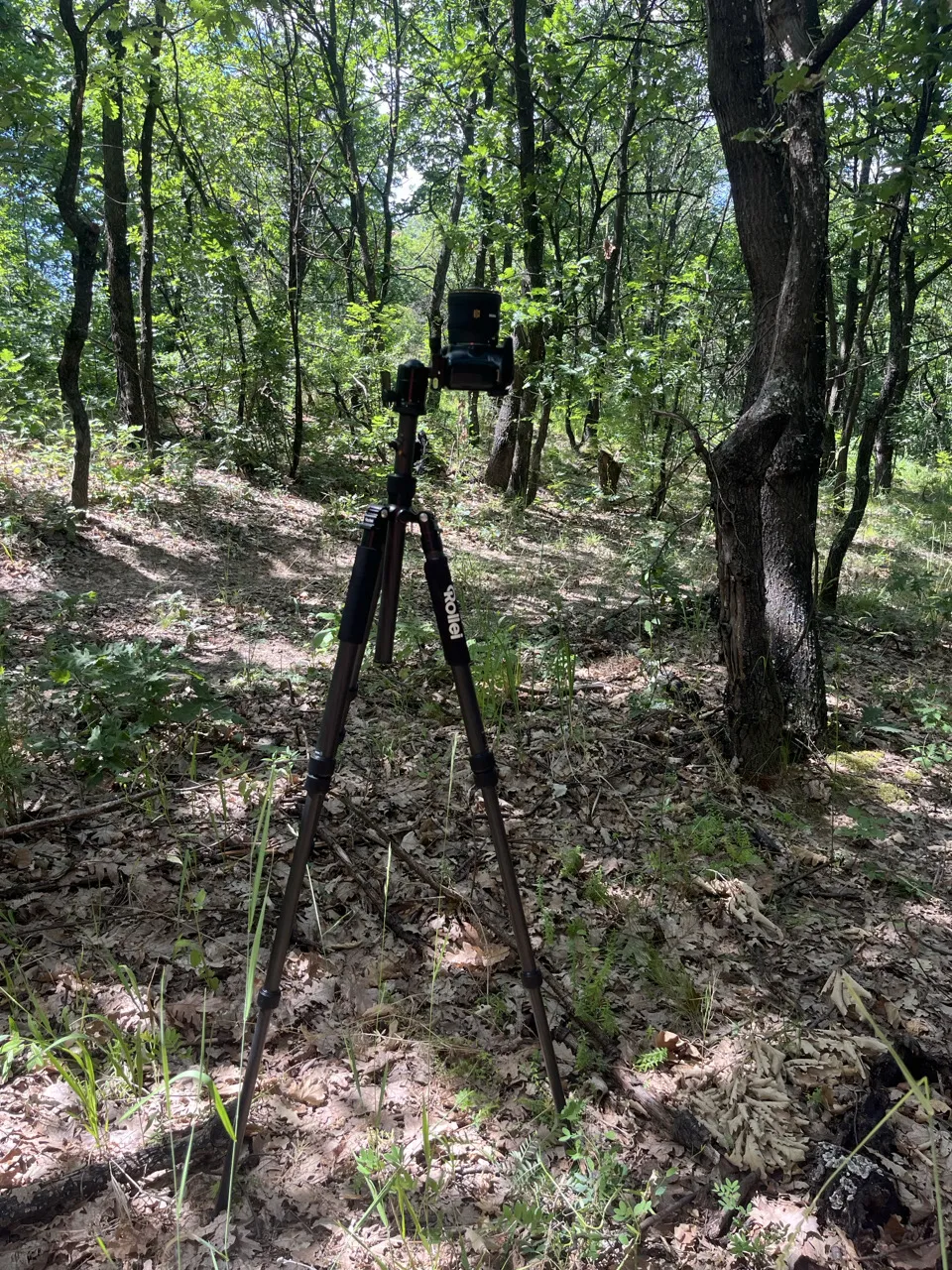
Photo: Leaf Area Index data collection. LAI measurements were collected with a fisheye camera beneath the forest canopy to support validation of UAV-derived vegetation structure indicators.
Grassland and pasture quality assessments were also carried out in the field. These observations are particularly important for linking UAV-derived spectral and structural indicators with ecological conditions observed directly on the ground. The aerial view of pasture areas in the Iron Gates region illustrates the type of landscape where these assessments are being performed, combining open grasslands, scattered woody vegetation and complex terrain.
By combining LiDAR, multispectral, thermal and in situ measurements, the Romania use case is building a multi-source dataset for AI-supported biodiversity monitoring. The UAV data provide very high spatial detail, while the field observations provide the ecological reference needed to train, calibrate and validate models. With two campaigns already completed and two more planned, the dataset will allow the team to analyse seasonal changes in ecosystem structure, vegetation condition, pasture quality and surface temperature patterns.
These activities contribute directly to BioClima’s broader objective of improving biodiversity and climate monitoring through the integration of in situ observations, UAV data, satellite products and AI-based analytical workflows. The Romania use case demonstrates how advanced Earth observation technologies can be combined with classical field ecology to better understand complex landscapes and support future biodiversity monitoring strategies.